

A Decision Made, Questions Left Open
For decades, products commonly called amyl or poppers were sold openly in New Zealand sex shops and sex-on-site venues, usually behind labels such as "leather cleaner" or "VHS head cleaner". Everyone knew what they were really being bought for.
When I first started investigating how that market changed, I thought the story was relatively straightforward. Australia changed its classifications, New Zealand followed, amyl became prescription-only, and a community that had previously bought poppers openly suddenly found itself pushed towards doctors, personal imports or an unregulated market.
I was wrong about an important part of that history. Amyl didn't suddenly become prescription-only in 2020. It had technically been a prescription medicine in New Zealand for years. When I put eight questions to Medsafe and the Minister of Health in July 2026, Medsafe's response corrected several other parts of my original understanding as well.
So I went back to the source material: the agendas and minutes of the Medicines Classification Committee (MCC), public submissions, Official Information Act material, research papers and Medsafe's new response. What emerged was more complicated — and in some respects more concerning — than the story I had originally set out to investigate.
The question is no longer simply why New Zealand classified amyl the way it did. It is whether the process that followed was ever properly completed — and whether Medsafe's present description of that process can be reconciled with the MCC's contemporaneous record.
First, Amyl Isn't Just Another Name for Every Bottle of Poppers
This distinction is fundamental to the story. "Poppers" is a catch-all term for a family of chemicals called alkyl nitrites. Amyl nitrite is one of them. Isopropyl nitrite is another. They aren't identical chemicals, and the evidence of harm isn't identical either.
That matters particularly when it comes to eye damage. Poppers-related maculopathy is real, but the strongest documented association is with isopropyl nitrite, not amyl. Earlier literature identified around 30 published cases internationally, while a 2025 review identified 59 cases across 19 studies. Against decades of widespread use, that remains an uncommon, documented outcome, but it shouldn't be dismissed. What matters for this story is which compound caused what harm.
New Zealand's own Medicines Classification Committee would eventually recognise that distinction. Australia had already built it directly into its regulatory response.
Amyl Was Already Prescription-Only — at Least on Paper
One of the biggest corrections Medsafe made to my original understanding concerns what actually happened in 2020. Amyl nitrite, isoamyl nitrite, butyl nitrite, isobutyl nitrite and octyl nitrite were already classified as prescription medicines in New Zealand. According to Medsafe's 2026 response, those individual substances had been prescription medicines since 1999.
The gap was elsewhere: isopropyl nitrite and n-propyl nitrite weren't classified at all. New Zealand therefore had an unusual situation. The law said several individual nitrites were prescription medicines, while products containing alkyl nitrites continued to be openly sold and used as poppers. The legal classification and the real-world market were effectively operating in different worlds.
What happened in 2020 was the creation of a new group classification for alkyl nitrites. That brought previously unscheduled compounds, including isopropyl and n-propyl, within prescription classification as well. And the reason New Zealand started looking at the issue was Australia.
Australia Had Already Decided the Compounds Shouldn't All Be Treated the Same
Australia announced its final decision on 6 June 2019. Rather than treating every alkyl nitrite identically, its regulator created different classifications for different compounds. Amyl nitrite was made less restrictive, moving from prescription to pharmacist-level access. Isoamyl, butyl, isobutyl and octyl remained prescription medicines. At the other end of the scale, isopropyl and n-propyl nitrite were prohibited.
That entire Australian decision was placed before New Zealand's MCC under the heading "Harmonisation of the New Zealand and Australian schedules." Australia had effectively moved in two directions at once: tighter controls on the compounds it considered more concerning and easier access to amyl.
New Zealand ultimately did neither.
The First MCC Meeting Left One Important Question Open
The MCC considered alkyl nitrites at its 63rd meeting on 10 October 2019. Only one public comment had been received, but once the Committee started discussing the issue, gaps in its knowledge became apparent. Members wanted more information about risks and drug interactions, including interactions with sildenafil. They recognised that men who have sex with men were a particularly relevant population and questioned whether the LGBTQI community even knew the classification was being considered. The Committee suggested that community feedback should be sought.
This is where the history needs to be precise. The MCC didn't decide it was incapable of doing anything. Instead, it "resolved to make a recommendation regarding the group entry only" while asking Medsafe for further information about the individual nitrites, "in particular amyl nitrite." The group recommendation therefore proceeded, closing the gap that had left substances such as isopropyl and n-propyl unscheduled.
What didn't proceed was a final decision about whether amyl itself should be treated differently and down-scheduled, as Australia had done. Alkyl nitrites were specifically placed on the agenda for the next meeting. That distinction is critical to everything that followed: the group decision had been made; the amyl question had not.
At the Same Meeting, Codeine Got a Very Different Kind of Examination
There was another Australian harmonisation issue before the MCC at that same meeting: codeine. The comparison is revealing because, when discussing codeine, the Committee expressly said its recommendation should be based on a balanced benefit-risk assessment in the New Zealand market, rather than simply following what Australia had done.
Its discussion ranged across benefits, harms, alternatives and practical consequences. Members considered Australian evidence following rescheduling, poisoning calls, possible unintended consequences, pressure on GPs, black-market supply, rural access and alternative treatments. Alkyl nitrites and codeine are obviously different substances presenting different regulatory issues, so the comparison doesn't prove that the alkyl-nitrite process was improper. It does, however, demonstrate the level of scrutiny the same Committee was capable of applying to an Australian harmonisation issue.
At the same time it was examining codeine in that depth, the MCC was acknowledging that it needed more information about individual nitrites, wasn't clear about aspects of their risks, and wasn't sure whether the community most affected even knew the issue was being considered. That contrast matters.
What Changed in March 2020
New Zealand's group classification was subsequently gazetted in March 2020 as "Alkyl nitrites; except when specified elsewhere in the schedule." This is another point where my original understanding needed correcting. The Gazette notice didn't suddenly turn amyl into a prescription medicine. Amyl was already prescription-only.
What the notice did was implement the group classification the MCC had recommended while the separate question of potentially down-scheduling amyl remained outstanding. Looking again at the 63rd minutes, Medsafe's explanation of this part of the history is supported by the record.
The public consultation that followed therefore wasn't about whether the already-recommended group entry should proceed. It was aimed at the unresolved question of amyl. Once the affected community knew what was happening, the response looked very different.
One Submission Became Hundreds of Voices
Only one public comment had been received before the 63rd meeting. The later consultation attracted substantial community feedback, including a petition carrying more than 700 signatures. One submission came from a 62-year-old man who said he had used amyl since 1980. He described feeling intimidated and deterred from participating in the process and questioned its legitimacy.
This wasn't simply more noise around a decision that had already been completed. Medsafe has now confirmed that the consultation was intended to inform the still-outstanding question of whether amyl should be down-scheduled.
That makes what happened to this evidence important, because when the MCC met again it still wasn't ready to decide.
COVID Delayed the Story — but Doesn't Finish It
In April 2020, an Official Information Act request sought information behind the Committee's consideration of alkyl nitrites. Further material concerning the individual nitrites was still being prepared. I originally interpreted that as evidence that the entire classification had proceeded without information the MCC itself said it needed. That interpretation was too broad: the group recommendation had already been made, while the unfinished work concerned the individual compounds, particularly amyl and whether it should be down-scheduled.
COVID also needs to be acknowledged. New Zealand entered lockdown in late March 2020, disrupting the MCC timetable and delaying normal government processes. Not every delay in this story can reasonably be blamed on Medsafe or the Committee.
But COVID explains delay. It doesn't answer what happened when the process resumed.
The 64th Meeting Is Where the Story Really Changes
The agenda for the MCC's 64th meeting was published on 24 June 2020. Alkyl nitrites appeared under "Update on outstanding agenda items from the 63rd meeting." The reports were described as "currently in progress" and as supporting information papers rather than new proposals. Nine months after the original meeting, the Government's own documentation was still describing unfinished work.
Then, on 9 July, the Committee made the position explicit: "no decision was made on down scheduling of any individual alkyl nitrite as the Committee felt it did not have enough information." By now, however, the MCC knew considerably more than it had nine months earlier. Community feedback had provided information about how poppers were actually used and raised concerns about access and possible alternative classifications.
More importantly, the Committee now recognised that the compounds didn't present identical risks. It recorded that adverse reactions and interactions involving isopropyl and n-propyl nitrite were more serious than those involving the other alkyl nitrites. That is a significant finding. The regulatory discussion had begun with "alkyl nitrites" but had now reached the point where the Committee itself recognised that different members of that group had different risk profiles. Australia had already responded to exactly that problem by treating the compounds differently.
The MCC had also contacted Australia's Therapeutic Goods Administration and learned there was still no approved amyl product available over the counter, although there had been some interest in submitting one for approval. Members wanted to know more: what had happened to Australian businesses following the changes, was there evidence supporting claims that a black market had developed, and what other consequences had followed?
Then the Chair introduced something particularly important into the discussion: the documented harms that could arise from people not having access to poppers, including anal tears. The regulatory question was no longer simply what harm can this product cause? It was also becoming what harm can restricting this product cause? A proper benefit-risk assessment needs both sides, and according to the minutes, the MCC still didn't believe it had enough information to reach the end of that assessment.
"More Information from the Community Was Needed Before a Decision Could Be Made"
That sentence in the 64th meeting minutes is probably the most important sentence in this entire history. The Chair proposed meeting the affected community with other Ministry officials. The purpose was to explore options, understand problems accessing these products through health professionals and determine the next steps.
The minutes then state: "More information from the community was needed before a decision could be made." The formal conclusion was equally clear: "The Chair and Ministry officials will meet with the sector while further information on impacts in Australia is sought."
At that point, the documentary trail is straightforward. The MCC says it needs more information. It identifies two sources for that information — the affected community and further investigation of Australia — and says the information is required before a decision can be made.
The obvious question is what happened next.
The MCC Already Knew a Prescription Could Be a Barrier
The same minutes contain another acknowledgement that has become increasingly important. The Committee was understandably uncomfortable with completely removing healthcare professionals from the process because alkyl nitrites can interact dangerously with some medicines and medical conditions. But it also acknowledged that "some people would not be comfortable going to their GP."
That wasn't a concern invented years later by critics of the policy. The MCC itself recognised it in 2020. The community engagement therefore had a practical purpose: officials were supposed to understand the barriers people experienced in accessing these products through healthcare professionals and explore possible alternatives.
The Committee even changed how it wanted similar cases handled in future. Australian harmonisation items should initially come before the MCC for discussion rather than immediately moving towards a recommendation. The reason recorded in the minutes was that this would allow the Committee "to reach out to the affected communities discuss matters arising to avoid unintended consequences."
That isn't an admission that the alkyl-nitrite process was unlawful, and it shouldn't be presented as one. But after dealing with this issue, the Committee itself decided that future harmonisation matters should involve affected communities earlier to avoid unintended consequences. It is reasonable to ask whether it ever went back and properly completed that exercise for the community already affected by this one.
Then Four Organisations Asked for the Brakes to Be Put On
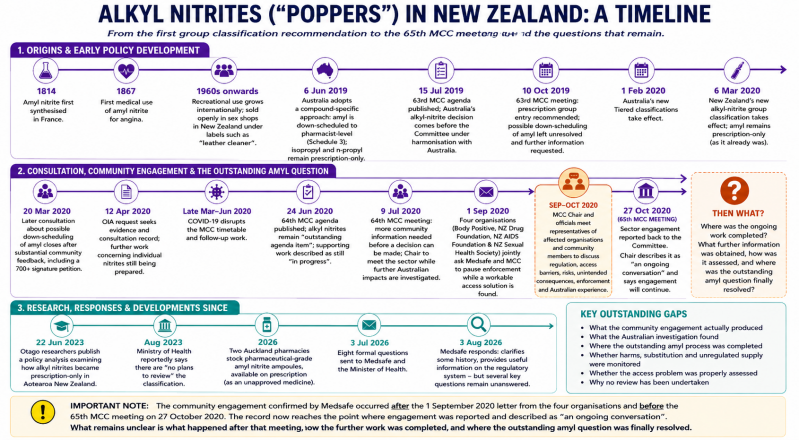
On 1 September 2020, Body Positive, the NZ Drug Foundation, the NZ AIDS Foundation and the NZ Sexual Health Society jointly asked Medsafe and the MCC to pause enforcement while a workable access solution was found. That was less than two months after the MCC had said more information from the community was needed before a decision could be made and that the Chair and Ministry officials would meet with the sector.
The timing matters. These weren't organisations arriving after the problem had been resolved. They were still sufficiently concerned about what the new rules meant in practice to jointly seek an enforcement pause and a workable solution.
We now know that direct sector engagement followed. The Chair and officials met representatives from affected organisations and community members, and that engagement was subsequently reported back to the MCC at its 65th meeting on 27 October 2020.
We don't yet have the exact date or dates of those meetings, but the MCC record narrows the period considerably: they occurred after the 64th meeting on 9 July and before the 65th meeting on 27 October 2020.
That gives us a much clearer sequence than I originally had: the MCC said it needed more community information, four organisations sought a workable solution, officials met with the sector, and the engagement was then reported back to the MCC.
But the 65th meeting doesn't close the story.
The 65th Meeting: The Conversation Was Still Ongoing
At the 65th MCC meeting on 27 October 2020, the Committee was told that the Chair, Secretary and Manager of Product Regulation had met with the sector. The discussion had covered regulation, use and misuse, risks and unintended consequences, enforcement and the effects being seen in Australia.
That is an important correction to my earlier understanding. The promised community engagement didn't simply disappear from the MCC record. It was reported back to the Committee.
But the minutes provide only a brief summary of the engagement. They don't tell us in any detail what the community told officials, what access barriers were identified, what solutions were proposed, or what conclusions were reached. Nor do they set out the results of the further investigation into Australian businesses, black-market concerns and other consequences that the 64th MCC had requested.
Most importantly, the Chair didn't describe the issue as resolved. The minutes record it as "an ongoing conversation", with further engagement to continue.
That moves the central question forward. It is no longer did the community engagement happen, and did it ever get back to the MCC? We now know that it did.
The question is: what happened after the 65th meeting?
What Actually Happened Inside Those Meetings?
Timing isn't the only issue. The 64th MCC minutes said more information from the community was needed before a decision could be made. Officials wanted to explore options, understand access problems and determine next steps.
Medsafe's 2026 description of the eventual meetings includes discussions about regulation, use and misuse, risks, unintended consequences, enforcement and Australian developments. It also describes officials explaining the medicines-approval process, provisional approval and the legal mechanisms allowing doctors to prescribe unapproved medicines or facilitate personal importation. Pharmaceutical-grade amyl ampoules were discussed too.
Some of that clearly overlaps with what the MCC wanted. But Medsafe's account tells us considerably more about what officials explained to the community than about the information the MCC said it needed from the community. That distinction is important. The meetings may well have involved extensive two-way discussion that simply isn't captured in Medsafe's response, but without the records we can't know.
What barriers did community representatives describe? What did people say about approaching their GP? What alternatives did they propose? Were sexual-health clinics, pharmacists, trusted community organisations or other access models discussed? What did officials learn about unintended consequences? Were recommendations made, and if so, what happened to them afterwards?
The 65th MCC minutes confirm that the engagement occurred and was reported back to the Committee, but they don't answer those questions. Instead, the Chair described it as "an ongoing conversation" and said engagement would continue. Those aren't minor details. They go directly to the information the MCC had said it needed before deciding.
This Is Where the Documentary Trail Becomes Difficult to Follow
The public record can now be followed further than I originally realised. The 63rd meeting made the group recommendation but left amyl unresolved. The 64th meeting said more information was needed before a decision could be made. Community organisations subsequently sought a workable solution, officials met with the sector, and the engagement was reported back to the 65th MCC meeting on 27 October 2020.
But the 65th minutes don't record a final resolution. Instead, the Chair describes the engagement as "an ongoing conversation" and says it will continue.
There is now an additional problem. Medsafe's 2026 response says that "the MCC agreed that they were unable to recommend down-scheduling amyl nitrite." Yet the contemporaneous 64th meeting record says "no decision was made" because the Committee did not have enough information and that more community information was needed before a decision could be made. The next published record, from the 65th meeting, still describes the resulting engagement as an "ongoing conversation."
Those accounts need to be reconciled.
If the MCC subsequently reached the position Medsafe now describes, the question should be relatively easy to answer: when did it do so, at what meeting, on what evidence and where is that decision recorded?
So the missing part of the story now begins after the 65th meeting. Where did that ongoing conversation lead? What further information was obtained from the community? What did the requested investigation of Australia's experience find? Were alternative access models developed or rejected? Was that information brought together in a completed benefit-risk assessment of amyl?
Most importantly, where is the final step that closes the outstanding amyl process?
If that record exists, it could answer many of the questions raised in this article. If it doesn't, the question becomes much more fundamental: how and when did an "ongoing conversation" become the completed MCC position Medsafe now describes?
Meanwhile, the Real-World Market Carried On
Whatever was happening inside the regulatory process, people didn't stop using poppers. Products continued circulating outside the medicines system, often with users having little reliable information about which alkyl nitrite a bottle actually contained. That matters because the MCC itself had recognised that isopropyl and n-propyl were associated with more serious adverse reactions than the other alkyl nitrites.
If regulation pushed people away from a known compound towards unidentified products, that would be an important unintended consequence. But did that actually happen? Did people switch compounds after 2020? Did isopropyl become more or less common? Did unregulated supply increase? Did adverse events change? And did the prescription system provide meaningful access?
These are measurable questions. I specifically asked Medsafe what monitoring had occurred after 2020 and what evidence informed the Ministry's reported 2023 position that there were no plans to review the classification. Its response doesn't identify post-2020 monitoring that answers them.
Researchers Later Asked How We Got Here
In 2023, Rebecca Crossin, Joe Whelan, Elizabeth Hughes and Benedicta Birks Ang published a policy analysis in the International Journal of Drug Policy examining how alkyl nitrites became prescription-only in Aotearoa New Zealand. They weren't conducting a clinical trial of poppers; they were examining the policy-making process itself.
Their description is striking. They said the issue entered a "somewhat pre-determined pathway with limited policy choices available." In other words, New Zealand hadn't started with a blank sheet of paper and asked what the safest and most practical way to regulate these substances might be. The issue arrived through Australian harmonisation and entered the existing medicines-classification machinery.
The researchers also identified two competing ways of framing the problem. Regulators focused heavily on uncertainty: there wasn't enough evidence to be confident about safety. Community and advocacy submissions focused on something different: limited evidence of significant real-world harm, recognised sexual-health benefits, and the possibility that restricting access could itself cause harm.
Those two perspectives never seem to have been fully reconciled. The uncertainty argument prevailed.
But Did the MCC Ever Actually Understand Amyl?
This has become one of the biggest questions for me. The MCC itself said it needed more information about individual nitrites, "in particular amyl nitrite." By the 64th meeting, it knew the compounds didn't all carry the same risk profile. It knew isopropyl and n-propyl were associated with more serious adverse reactions. It had heard about benefits and harms associated with restricting access, and it wanted more information from both the community and Australia before deciding.
The question is whether it ever completed that work. Did the eventual assessment bring together amyl's pharmacological effects, why people use it during sex, its muscle-relaxing and sexual-health effects, adverse events, medicine interactions, how its risks differ from isopropyl and the consequences of restricting access? If such an assessment exists, where is it in the record?
There is an important distinction here. "Evidence shows amyl needs to remain prescription-only" is not the same conclusion as "there isn't enough evidence to prove amyl can safely be made easier to access." Medsafe's response appears much closer to the second. Because there is no approved amyl product, it says, there is limited clinical information about its safety, and the MCC therefore didn't have sufficient evidence to recommend down-scheduling.
That may explain why the status quo remained. But an absence of sufficient evidence to remove an existing restriction is not, by itself, evidence demonstrating that the restriction remains proportionate to the demonstrated risks of amyl.
That distinction has become increasingly important. Was prescription-only status positively supported by a completed compound-specific benefit-risk assessment, or did it simply persist because the evidential threshold for changing an existing classification wasn't met?
That goes to the heart of whether the MCC ever truly finished understanding the product it was deciding how to regulate.
The People Most Affected Were Left with the Consequences
Poppers use isn't exclusive to gay and bisexual men; international research also records use among heterosexual men and women. But use is substantially concentrated among gay and bisexual men, and that community has consequently carried much of the impact of the regulatory decision.
By 2023, Body Positive's Mark Fisher was publicly describing the practical problem. He said roughly half of gay men in New Zealand weren't out to their GP and that he knew of only three doctors nationally willing to assist with prescribing for personal import. Meanwhile, some people were continuing to buy products of unknown quality through informal channels — including, as Fisher memorably described it, "out of a backpack at Big Gay Out."
Fisher's estimate is consistent with the only New Zealand research on the question. A 2015 study of 3,168 gay and bisexual men found that only 50.5% believed their usual GP was aware of their sexual orientation or behaviour, with the remainder either unsure or believing their GP was unaware.
A legal pathway existing on paper isn't necessarily meaningful access, and again the MCC had already recognised this problem in 2020 when it acknowledged that some people wouldn't be comfortable going to their GP. That is why one of my eight questions to Medsafe was very specific: has anyone assessed the effect of requiring gay and bisexual men to disclose their sexuality or relevant sexual practices to a doctor in order to obtain lawful access?
Medsafe didn't substantively answer that question. Nor is the discrimination concern something invented retrospectively for this article. Submissions in 2020 raised the effect of the changes on gay and bisexual men. University of Auckland researcher Dr Peter Saxton later said Medsafe could have been more wary of discrimination. Before either of those things, the MCC itself had questioned whether the LGBTQI community even knew the original issue was being considered.
None of that establishes unlawful discrimination. It does justify asking whether a disproportionate disclosure and access burden was ever properly assessed.
The Legal Pathways Exist. The Practical Pathway Doesn't.
There are currently lawful ways to obtain amyl. A doctor can prescribe pharmaceutical-grade amyl nitrite ampoules that some New Zealand pharmacies can source as an unapproved medicine. A doctor can also prescribe or facilitate the personal importation of an unapproved product from overseas. I deal with those options properly in Part 3.
For this story, the important point is that both roads lead back to a doctor and a prescription. That is particularly striking because Medsafe's 2026 response ultimately acknowledges that "there is not a practical regulatory pathway for safe access to these medicines."
Read that alongside the 64th MCC minutes. In 2020, the Committee knew some people wouldn't be comfortable approaching their GP. It wanted to understand that problem and explore options. Six years later, Medsafe itself says there still isn't a practical pathway for safe access.
That isn't simply a historical curiosity. It is an unresolved regulatory outcome.
New Zealand's Approach Diverged from Australia's
Medsafe has provided a legitimate explanation for one difference between Australia and New Zealand. New Zealand doesn't have a direct equivalent to Australia's Schedule 10, which Australia used to prohibit isopropyl and n-propyl nitrite. Simply copying that part of Australia's decision therefore wasn't straightforward.
Australia's decision had another half, though: it made amyl less restrictive. New Zealand has pharmacist-based medicine classifications of its own, yet amyl remained prescription-only here even after the MCC recognised that different alkyl nitrites carried different risk profiles.
The lack of an equivalent to Schedule 10 explains part of the divergence between the two countries. It doesn't fully explain why New Zealand didn't align with Australia's less restrictive treatment of amyl itself.
Then There's the Approved-Product Trap
At the 64th meeting, the MCC observed that classification discussion was "moot without an approved product in the market." Six years later, there still isn't an approved alkyl-nitrite medicine in New Zealand. Medsafe says no application has ever been made and also points out that simply changing classification wouldn't solve the current access problem because an unapproved medicine would still require a doctor.
Technically, that is important. Practically, it creates a circle. There isn't enough approved-product clinical information to support easier access; there is no approved product generating that information; nobody has applied to approve one; changing classification alone won't make an unapproved product available through pharmacies; and the lawful alternatives still require a doctor.
Each individual part of that system can therefore be explained, while the overall problem remains unsolved. Nobody necessarily has to make an obviously wrong decision for the final outcome to fail the people the system is supposed to serve.
And six years later, the problem remains.
Australia and the UK Haven't Completely Solved It Either
New Zealand isn't alone in struggling with this. Australia's classification looks more sophisticated on paper because amyl can be supplied at pharmacist level, but without an approved product that hasn't produced the pharmacy market the classification appears to promise.
The United Kingdom illustrates a different problem. Practical access is much easier, but much of its market has historically relied on products being sold under descriptions that don't honestly reflect why customers buy them. That isn't particularly satisfactory regulation either. A product people inhale shouldn't become easier to sell simply because nobody is allowed to say honestly that people inhale it.
The regulatory challenge is actually fairly simple to describe, even if solving it isn't: how do you give adults practical access to a known compound, of known strength and quality, with honest safety information and proportionate safeguards?
New Zealand still doesn't have an answer.
What Medsafe Answered — and What It Didn't
Medsafe's August 2026 response was useful. It corrected parts of my original understanding, and those corrections belong in this story. Amyl didn't suddenly become prescription-only in 2020. The March Gazette implemented the group classification while possible down-scheduling of amyl remained a separate issue. The later consultation concerned that outstanding question. Community meetings did occur. And New Zealand's lack of an equivalent to Australia's Schedule 10 explains part of the divergence between the two countries.
But several of my most important questions remain unanswered. Medsafe hasn't provided the exact dates of the community meetings, although the MCC record establishes that they occurred between the 64th and 65th meetings. I still don't know in any detail what information the community supplied, what solutions were proposed, what the requested further Australian investigation found, or where that subsequent information was finally considered.
Most significantly, Medsafe now describes an MCC conclusion that I cannot reconcile with the published minutes. It says the MCC "agreed that they were unable to recommend down-scheduling amyl nitrite." The 64th minutes instead say no decision was made, further information was required and more community information was needed before a decision could be made. The 65th minutes then report the engagement but describe it as "an ongoing conversation."
That is no longer simply a question about missing detail. It is a question about where the decision Medsafe now describes was actually made.
Medsafe also didn't substantively answer whether the disproportionate impact on gay and bisexual men had ever been assessed. It didn't identify post-2020 monitoring that answers what happened to harms, substitution between compounds, unregulated supply or practical access. Nor did it provide the evidential basis for the Ministry's reported 2023 position that there were no plans to review the classification.
In several places, the response instead explains how the regulatory system works and how an individual can legally obtain an unapproved medicine. That is useful information, but it isn't what I was principally asking. My questions were not really "How can I get amyl?" They were about how this regulatory process was completed, what evidence supported its outcome, whether the consequences were assessed, and whether the people most affected were properly considered.
Ironically, Medsafe's answers have made those remaining gaps easier to see.
The Questions That Still Need Answers
After going back through the record, I don't think this story needs accusations. It needs answers.
Where is the MCC decision Medsafe now describes? At what meeting did the MCC agree that it was unable to recommend down-scheduling amyl, where is that conclusion recorded, and what evidence was before it?
How is Medsafe's present account reconciled with the 64th minutes? Those minutes expressly say no decision was made because the Committee lacked sufficient information and that more community information was required before a decision could be made.
What happened after the 65th MCC meeting? The sector engagement had occurred and was reported back, but the Chair described it as "an ongoing conversation." Where did that continuing work lead?
Did the MCC ever properly understand amyl itself? Did it obtain the information it said it needed about amyl's risks, benefits, effects, real-world use and how its risk profile differs from other alkyl nitrites?
What did the community engagement actually produce? What access barriers did representatives identify, what solutions did they propose, what did officials learn and what happened to that information?
What happened to the further Australian investigation requested by the 64th MCC? What was learned about Australian businesses, the reported black market and other consequences, and how was that information used?
Was keeping amyl prescription-only ever positively supported by the evidence? Was there a completed benefit-risk assessment supporting that outcome, or did amyl remain prescription-only because there wasn't enough evidence to justify changing an existing classification?
Were the real-world consequences monitored after 2020? Did unregulated supply change? Did people switch compounds? Did harms change? Did the lawful prescription pathway actually provide meaningful access?
Did the regulatory approach actually make people safer? Was there any assessment of whether restricting lawful access resulted in people using products of unknown composition from an unregulated market instead?
What evidence supported the later position that there was no need for a review? If access, harms, substitution and the unregulated market weren't being monitored, what evidence showed that the existing classification was working as intended?
Was the impact on gay and bisexual men ever properly assessed? Was the burden on men who weren't out to their doctor, or weren't comfortable discussing their sexuality or sexual practices, ever formally considered?
What happened to the access problem the MCC itself identified? Six years later, both lawful pathways still require a doctor and Medsafe acknowledges there is "not a practical regulatory pathway for safe access to these medicines."
Why hasn't amyl received a fresh assessment? The compounds were recognised as presenting different risks, the access problem remains unresolved and Medsafe has not identified the compound-specific evidence demonstrating why prescription-only control of amyl remains proportionate.
Did Medsafe and the MCC ultimately conduct a process that meets the standard New Zealanders should expect when medicines are assessed? Was the product properly understood, were the people affected properly consulted, were benefits and risks properly balanced, were consequences examined, and was the process brought to a clear and documented conclusion?
Some of these questions may have straightforward answers sitting in records I haven't yet seen. If those records exist, they should be produced.
This Is Now Bigger Than Whether I Agree with the Classification
I'm not arguing that amyl has no risks. Alkyl nitrites reduce blood pressure and combining them with sildenafil and similar erectile-dysfunction medicines can be dangerous. Accidental swallowing can cause serious harm. Methemoglobinemia can occur. Eye injuries have been documented, particularly with isopropyl nitrite. Those risks deserve to be understood and regulated.
But good regulation isn't simply about identifying a hazard and restricting access. It means understanding the actual product, distinguishing between different compounds, weighing benefits against harms, considering the consequences of restrictions, listening to the population most affected and then checking whether the policy actually works.
Having followed the documentary record as far as I now can, I no longer think it is enough simply to assume that amyl's existing prescription-only classification must be the appropriate outcome because that is where the process ended up.
The MCC itself recognised different risk profiles among the alkyl nitrites. Australia responded to those differences with compound-specific classifications. The MCC identified access barriers and possible harms from restricting access. It said it needed more information before deciding. The subsequent engagement was still described as ongoing at the 65th meeting. And six years later, Medsafe acknowledges the absence of a practical regulatory pathway for safe access.
Most importantly, I still cannot identify the evidence demonstrating that amyl itself requires prescription-only control, as distinct from evidence showing there was insufficient information to recommend removing that control.
Those are not the same thing.
The existing classification should therefore be capable of being justified on the evidence rather than simply inherited from the past. I still can't see where that justification was completed.
Where This Stands Now
On 3 July 2026, I wrote to Medsafe's Group Manager and the Minister of Health with eight questions about the classification process, Australian harmonisation, compound-specific evidence, community engagement, access, discrimination and post-2020 monitoring. Medsafe replied on 3 August 2026.
Some of its answers genuinely changed my understanding, and I have corrected this article accordingly. But those answers haven't closed the story.
The 64th MCC said more information from the community was needed before a decision could be made, and officials were to meet the sector while further information about Australian impacts was sought. The sector engagement subsequently occurred between the 64th and 65th meetings and was reported back to the Committee. At the 65th meeting, however, the Chair described it as "an ongoing conversation" and said engagement would continue.
Medsafe now says the MCC agreed it was unable to recommend down-scheduling amyl. Yet I still haven't been provided with or identified the subsequent MCC record showing where that conclusion was reached, what further evidence was considered and how the outstanding process was brought to a close.
Behind that documentary problem sits an even bigger question: did the MCC ever reach the point where it properly understood amyl itself and could demonstrate that prescription-only classification was proportionate to its particular risks, benefits and real-world consequences?
That is now the central issue for me.
Accountability matters, but the larger issue is whether New Zealand has ended up with regulation that understands the product, understands the people using it, manages the genuine risks and provides a practical pathway safer than an unregulated market.
Six years after the MCC recognised that access was a problem, Medsafe itself now acknowledges that New Zealand still doesn't have a practical regulatory pathway for safe access.
The history deserves answers.
The problem still deserves a solution.
Key Takeaways
01 — THE PROCESS
The MCC said more information was needed before a decision on amyl could be made, yet it remains unclear where that further work was considered and the outstanding process formally completed. That raises a broader question about whether the process met the standard New Zealanders should expect when medicines are assessed.
02 — THE PRODUCT
The MCC recognised that alkyl nitrites are not all the same and that some carry more serious risks, yet it remains unclear whether amyl itself ever received a complete risk-benefit assessment. Before deciding how tightly a medicine should be restricted, we should expect the regulator to properly understand that particular compound — its risks, effects, benefits and real-world use.
03 — THE PEOPLE & THE OUTCOME
Six years later, the people most affected are still living with an unresolved access problem. The MCC knew some people would be uncomfortable going to their GP, the impact on gay and bisexual men remains unanswered, and Medsafe itself now acknowledges there is “not a practical regulatory pathway for safe access to these medicines.”
References
-
Crossin, R., Whelan, J., Hughes, E., & Birks Ang, B. (2023). A policy analysis of how alkyl nitrites (poppers) became prescription-only in Aotearoa New Zealand. International Journal of Drug Policy, 117, 104062.
-
Medicines Classification Committee. Agenda and Minutes of the 63rd Meeting, 10 October 2019.
-
Medicines Classification Committee. Agenda and Minutes of the 64th Meeting, 9 July 2020.
-
Medsafe. Classification of Alkyl Nitrites — response, 3 August 2026.
-
New Zealand Gazette. Medicines classification notice, March 2020.
-
Medicines Act 1981 and Medicines Regulations 1984.
-
Body Positive.
-
New Zealand Drug Foundation.
-
New Zealand AIDS Foundation / Burnett Foundation Aotearoa.
-
New Zealand Sexual Health Society.